THE BLOG
Bark.com reviews: is Bark worth it for UK tradespeople?
Bark can bring you work, but whether it pays depends on your job value and how many leads you actually win. Here's how Bark charges, what its own pages say about credits, what reviewers report, and a worksheet to work out your real cost per won job.
The short
answer.
The short answer: Bark can bring you work, but whether it's worth it depends on two numbers only you know: what a typical job is worth to you, and how many of the leads you pay for turn into paid jobs. Bark.com reviews online are mixed, and most are written by customers, not tradespeople. So don't decide from a star rating. Work out your cost per won job from Bark's own prices, then compare it with leads you own.
I'm James Gonzo at Collective Digital Media in Heywood. I build websites and Google profiles for trades, so weigh that up as you read. Bark hasn't paid to appear here and hasn't seen this page. Every Bark fact below comes from Bark's own pages, opened on 13 November 2026, and I've linked each one so you can check it yourself.
What Bark is and how it works for professionals
Bark is an online marketplace that matches customers with local professionals. A customer fills in a request for a service. Bark then sends that request out as a lead to professionals who offer the service in the area.
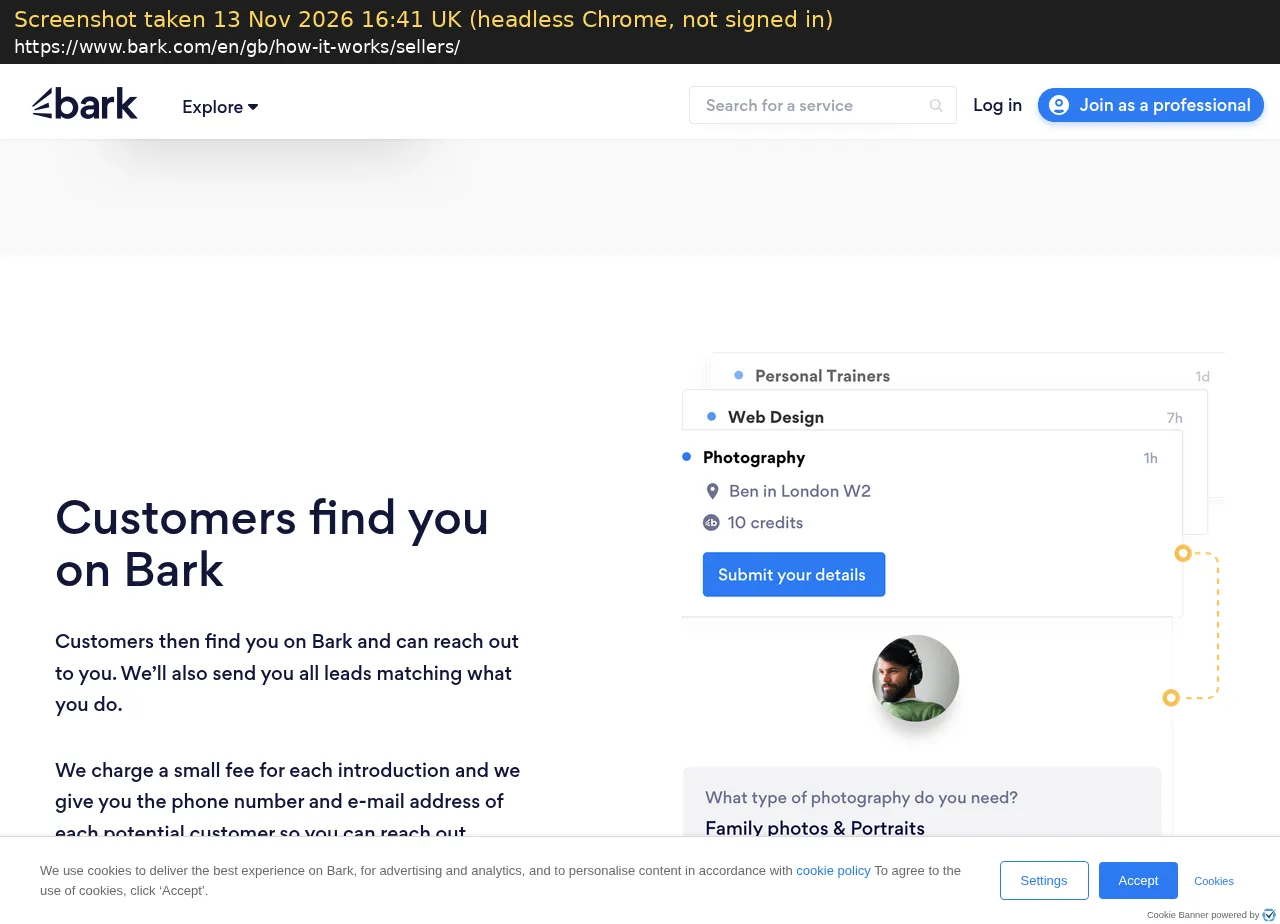
Bark's own UK page for professionals sets out the model in plain terms:
- Customers come to Bark with their needs, and Bark collects detailed information about what they're looking for.
- Bark sends you leads that match what you do, and customers can also find you on Bark and reach out.
- Bark charges a small fee for each introduction, and gives you the phone number and email address of each potential customer so you can get in touch.
- You get an online profile on Bark.
On the customer side, Bark's UK "how it works" page tells customers to compare the professionals, check their profiles, reviews and websites, then choose a favourite. That matters for you. You're usually not the only person getting that lead.
How Bark charges
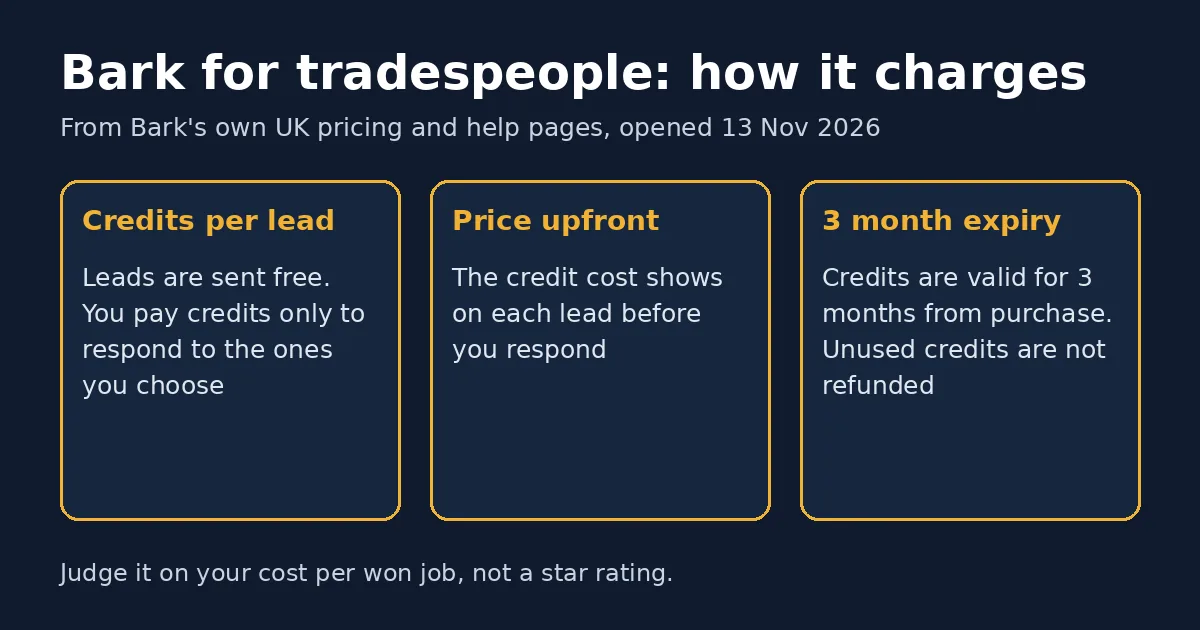
Bark runs on credits. You don't pay a monthly fee to receive leads. You pay in credits when you choose to respond to one.
Here's what Bark's UK pricing page for professionals says:
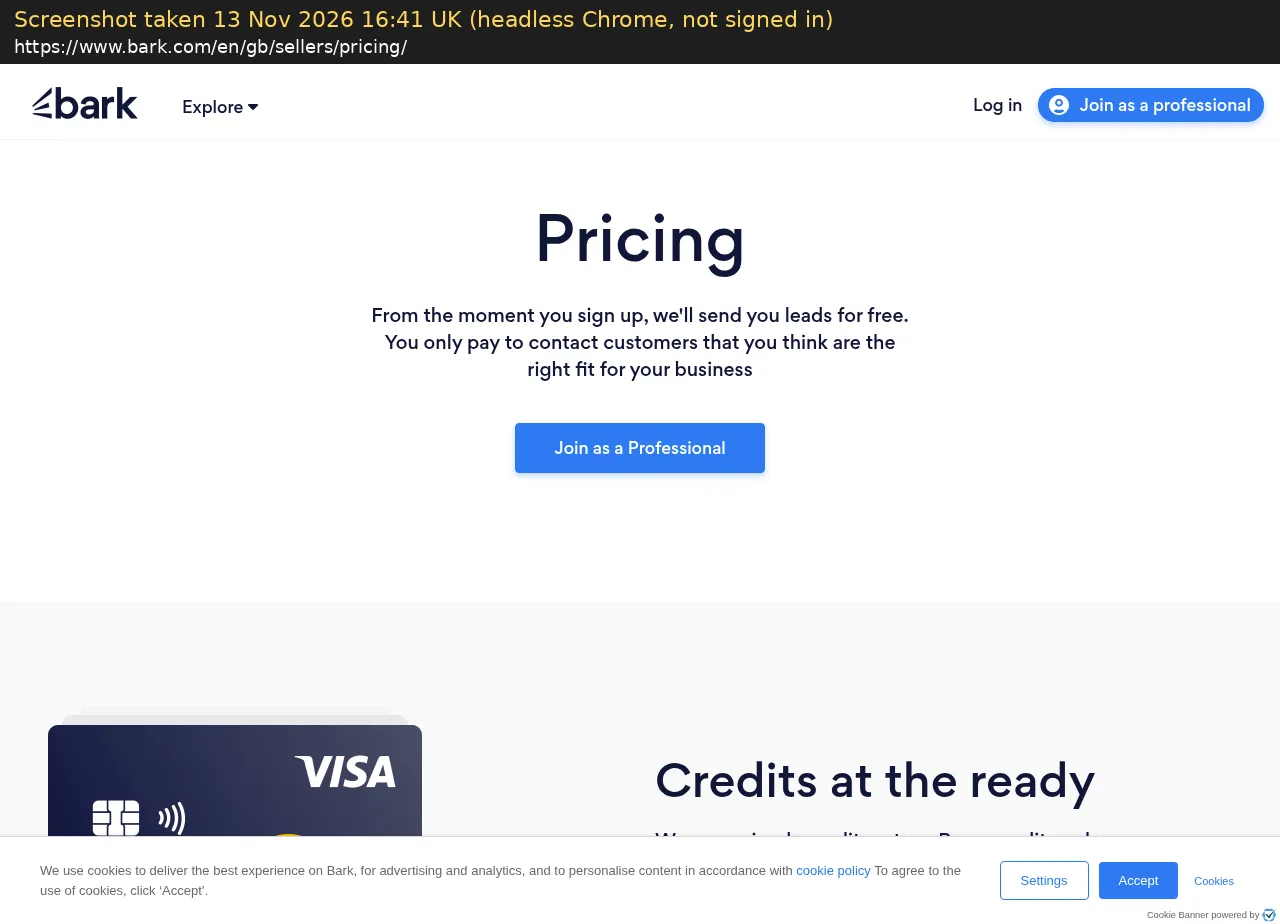
- From the moment you sign up, Bark sends you leads for free. You only pay to contact customers you think are the right fit.
- You buy a credit pack and use the credits to contact the customers you're interested in.
- You decide which leads to respond to, and you see the cost in credits upfront.
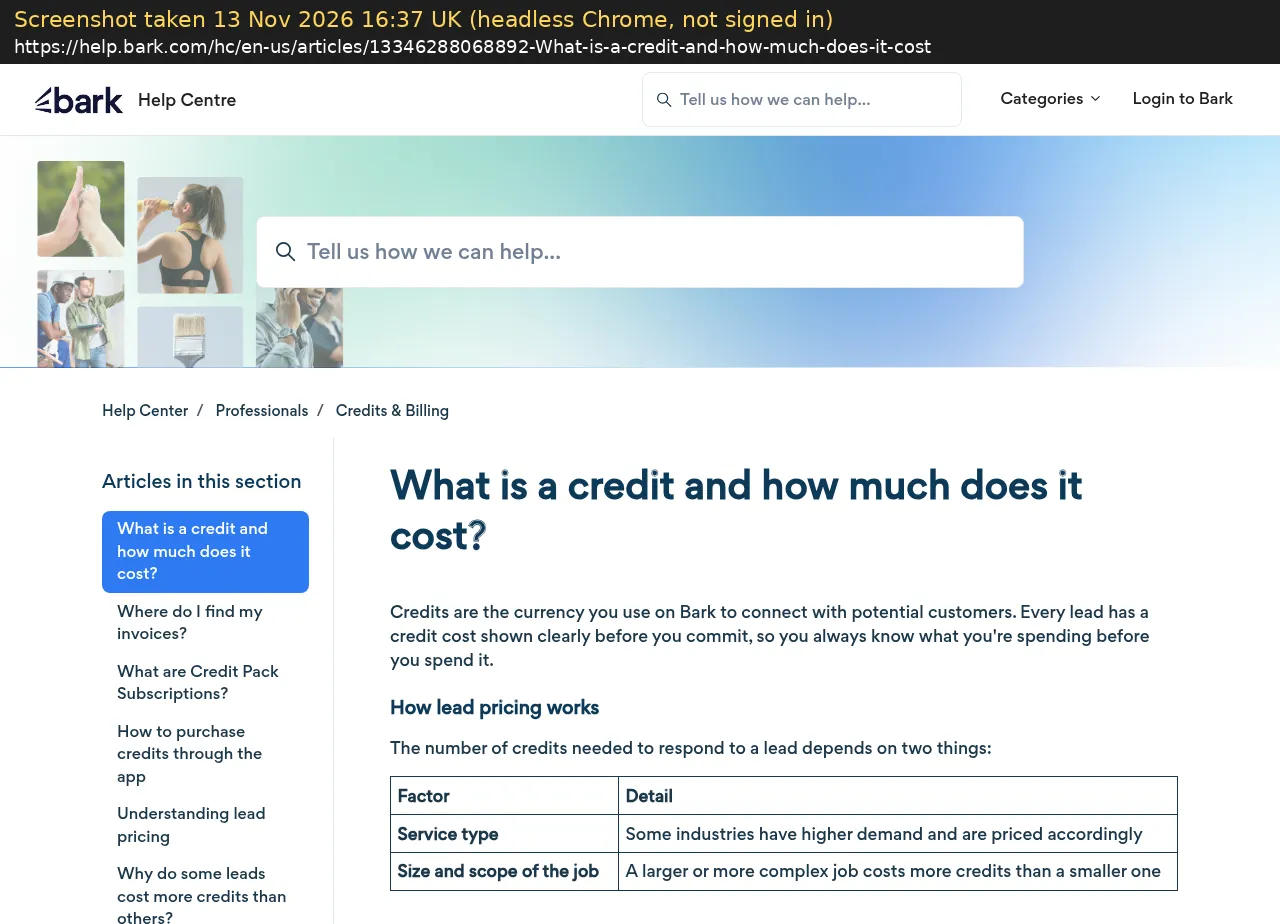
- Bark works out the cost of contacting a customer from the service, the value of the job and the supply and demand in the area.
- Follow up messages are free. Bark charges a one off fee to respond to a lead, and further contact with that customer costs nothing extra.
- Bark says there's no commission and no hidden costs.
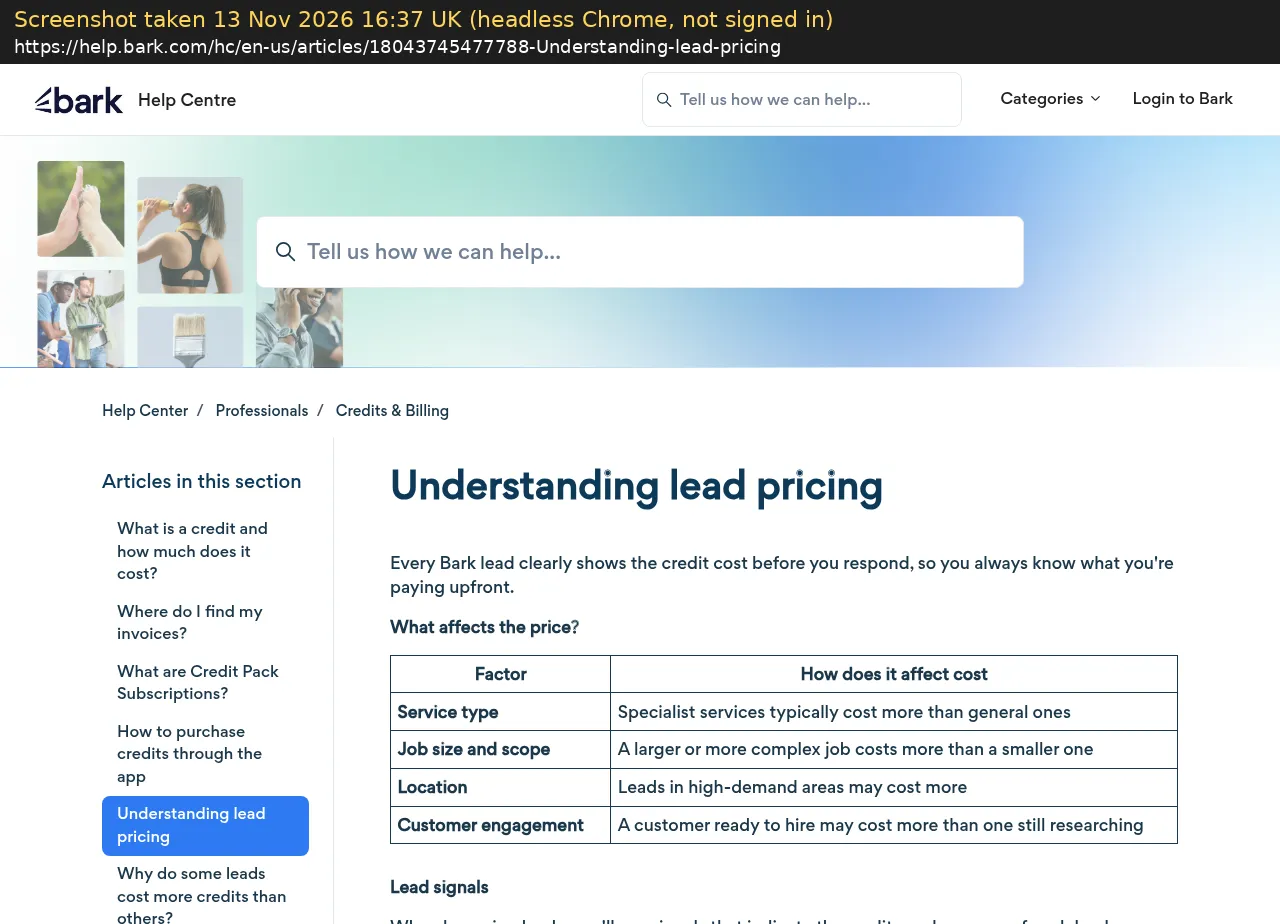
Bark's help centre article on lead pricing adds more detail. It lists four things that change the price of a lead:
| What changes the price | What Bark's help page says |
|---|---|
| Service type | Specialist services typically cost more than general ones |
| Job size and scope | A larger or more complex job costs more than a smaller one |
| Location | Leads in high demand areas may cost more |
| Customer engagement | A customer ready to hire may cost more than one still researching |
The same page says the credit cost is always shown on the lead before you confirm, so you're never charged without seeing the price first.
How much is a Bark credit in the UK?
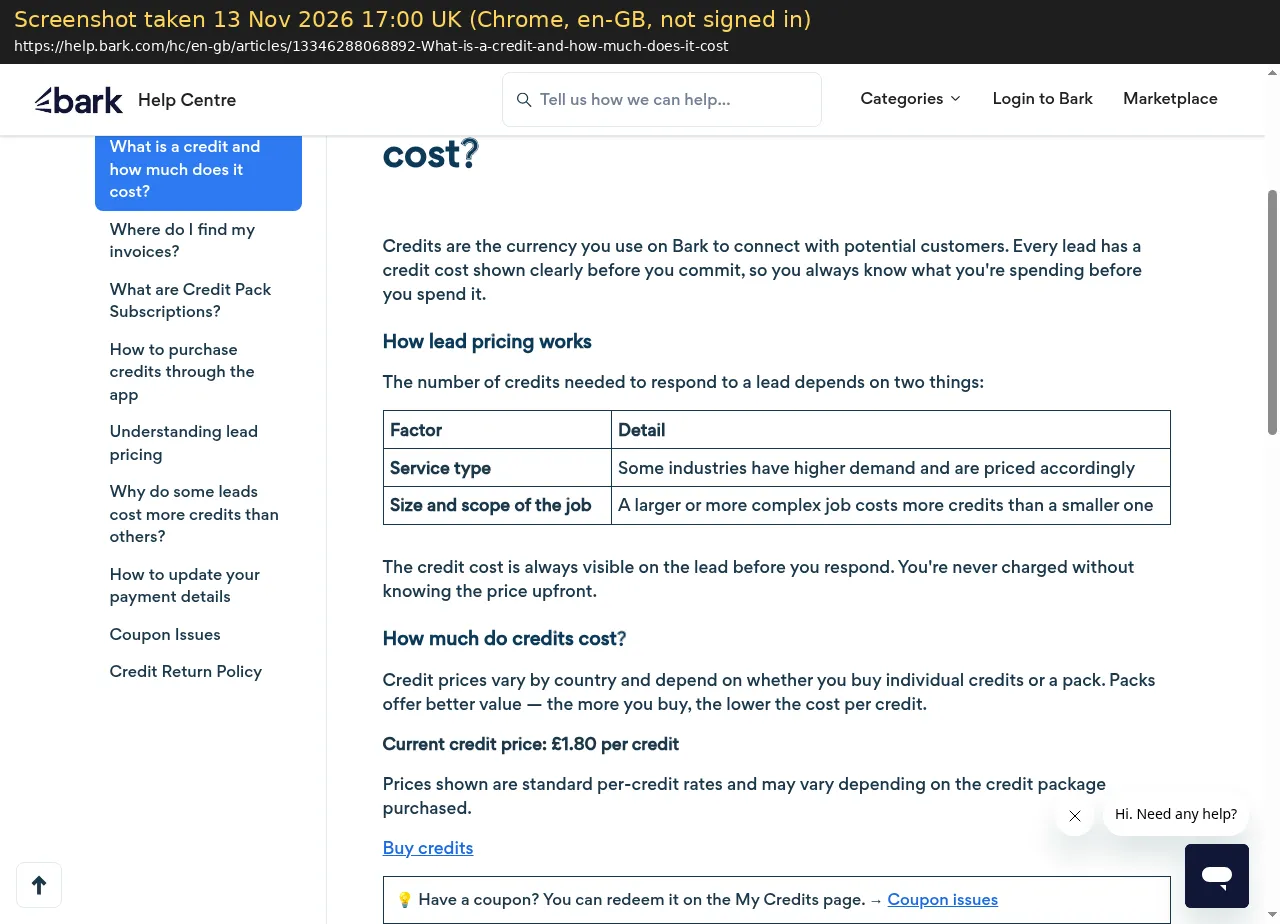
Bark's UK help article "What is a credit and how much does it cost?" says credit prices vary by country and depend on whether you buy single credits or a pack, with bigger packs costing less per credit. When we opened the UK version on 13 November 2026 (not signed in), it showed "Current credit price: £1.80 per credit", and said prices shown are standard per-credit rates and may vary depending on the credit package purchased. The UK pricing page itself doesn't list a per credit price.
So a lead's cost is the number of credits it needs, which Bark shows on each lead, times what you paid per credit. Check the price on the buy credits screen in your own account before you spend anything, because packs and offers change it. Don't rely on a figure from a review site or an old forum post.
Do Bark credits expire?
Yes. Bark's UK pricing page says all credits are valid for 3 months from the date of purchase. Bark's help article on credits gives the detail:
- credits bought from 1 November 2025 expire 3 months after purchase
- credits bought before 1 November 2025 expire 12 months after purchase
- unused credits can't be refunded
That 3 month window is the bit of small print that catches people out. If you buy a big pack to get a lower price per credit but only respond to a few leads a month, you could lose what you don't use.
Bark's first pack guarantee
Bark's UK pricing page says it's so confident you'll win business with your first credit pack that it will return all your credits if you don't, no questions asked. That's worth knowing if you want to test Bark. Read the terms on Bark's site before you rely on it, because the pricing page only mentions your first credit pack.
Bark's help centre also lists articles called "Credit Return Policy" and "What are Credit Pack Subscriptions?". Read both before you buy, and check whether auto top up is switched on. Bark's credits article says auto top up buys more credits automatically when your balance runs low.
What tradespeople say: Bark.com reviews
Most people searching for Bark.com reviews land on Trustpilot first. Here's what it showed when we opened it on 13 November 2026:
- a TrustScore of 3.8 from 112,536 reviews
- 66% of reviews at 5 stars and 8% at 1 star
- a note that Bark's profile is claimed and has a paid Trustpilot subscription
- a note from Trustpilot that it uses technology to protect platform integrity but doesn't fact check reviews
Those numbers will change, so check Bark's Trustpilot page yourself. The bigger point is who wrote the reviews. Bark has two sets of users: customers looking for someone, and professionals paying for leads. Trustpilot's own summary on 13 November said reviewers often mention how quickly professionals arrive and get the job done. That's the customer's view. It tells you Bark can put customers in touch fast. It doesn't tell you whether paying for leads will work for your trade.
So I also read what professionals wrote, on Trustpilot and in the MoneySavingExpert forum thread on Bark.com reviews. These are reported views from individual users, not facts we've checked:
- Customers who never reply. The most common complaint from professionals is paying credits to contact customers who then don't answer calls or emails. One trader on the forum said they made around twenty responses and got no replies.
- Lead quality. Some professionals report leads that weren't genuine. One recent Trustpilot reviewer, a US business, said Bark's support returned credits for leads that were bad.
- Refunds. Experiences differ. One professional on Trustpilot said support refunded credits for an incorrect lead. One trader on the forum said Bark wouldn't refund them.
- Lots of contact for customers. Some customers on the forum say they were called by many traders after posting a job, which tells you how busy some leads get.
- It works for some. One professional on Trustpilot said they found a plumbing customer through Bark and found the support team helpful, while still wanting better lead quality.
Bark's own help page gives you a clue about the competition point. It says one of the lead signals you'll see is "1st to respond", meaning no other professional has contacted the customer yet. In other words, on other leads, someone may have got there first.
You'll also see posts calling Bark a scam. I don't think that's a fair way to put it. Bark is clear on its own pages that you're paying for an introduction, not a job. The real question is whether those introductions turn into enough paid work for your trade and your prices.
Is Bark legit?
Yes, in the sense that it's a real company doing what its pages say. The site is run by Bark.com Global Limited, and its UK pages are open about the model: Bark sends you leads, you pay credits to respond to the ones you choose, and you get the customer's phone number and email. Bark doesn't promise that a customer will reply or hire you, apart from its first credit pack guarantee.
Where people get burned is expecting a paid lead to be a paid job. It isn't. It's a paid introduction to someone who may also be talking to other trades, or who may have moved on. If you go in knowing that, and you track what you spend, you can judge Bark on your own numbers rather than on someone else's bad week.
The small print that decides whether it's worth it
Before you buy any credits, check these on Bark's own pages and in your account:
- Expiry. Credits are valid for 3 months from purchase, according to Bark's UK pricing page. Bark's help centre says unused credits can't be refunded.
- Pack size. Bigger packs cost less per credit, Bark's help page says, but only if you use them within the 3 months.
- Auto top up. If it's switched on, Bark buys more credits automatically when your balance runs low. Decide whether you want that.
- Subscriptions. Bark's help centre has a separate article on credit pack subscriptions. Read it before you sign up to one.
- Returns. Bark's help centre has a credit return policy. Read what counts as a bad lead and how to ask for credits back.
- The guarantee. The pricing page mentions your first credit pack only.
- Price on the lead. Every lead shows its credit cost before you respond. If a lead costs more than it's worth to you, skip it.
None of this is hidden. It's just easy to skim past when you're keen to get work in.
Is Bark worth it? Work out your cost per won job
This is the same method I use in my post on Checkatrade vs your own website. Count the jobs, not the enquiries.
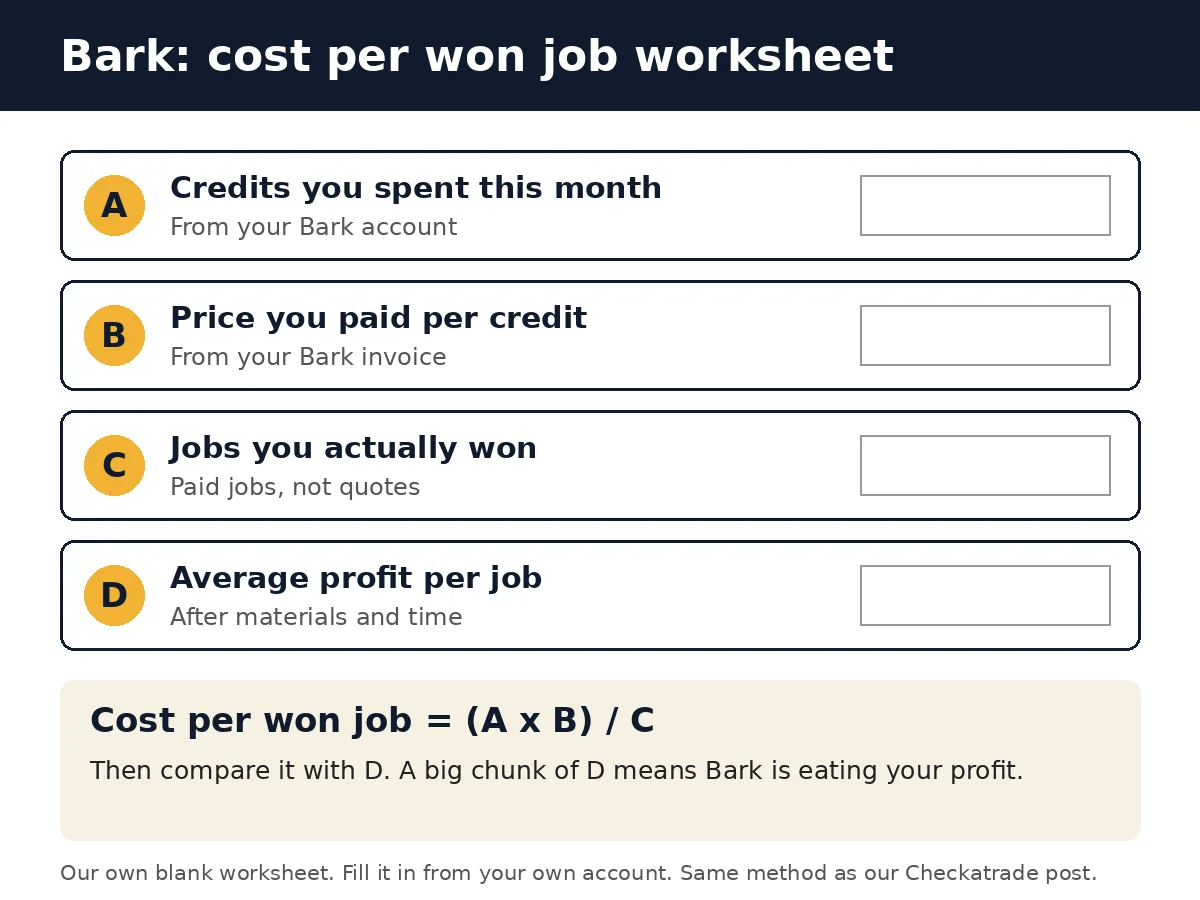
You need four numbers. All of them come from your own Bark account, not from me or a review site:
- A: credits you spent in a month, from your Bark account.
- B: what you paid per credit, from your Bark invoice. Bark's help centre has a page on where to find your invoices.
- C: jobs you actually won from Bark leads that month. Paid jobs, not quotes.
- D: average profit per job for your trade, after materials and time.
Then do two sums:
- Cost per won job = (A × B) ÷ C
- Does it pay? Compare cost per won job with D. If the cost per won job is a big chunk of D, Bark is eating your profit. If it's a small slice, Bark may be worth keeping.
A few tips that make the sum honest:
- Track every lead you pay for in a simple list: date, credits, job type, did they reply, did you quote, did you win.
- Give it a fair trial. One week is too short. Bark credits last 3 months, so a month or two of tracking gives you something to go on.
- Include your time. Calling and quoting customers who don't book costs you hours too.
- Watch for return requests. If Bark returns credits for a bad lead, take them off A.
If you can't fill in C because you don't know which jobs came from Bark, that's your first job. Ask every new customer how they found you.
When Bark can make sense, and when it doesn't
From Bark's own pricing rules, a few things follow. Bark says bigger, more complex jobs and specialist services cost more credits, and that leads where the customer is ready to hire may cost more. Bark also shows a "1st to respond" signal on some leads. Put that together and Bark tends to suit some businesses better than others.
Bark can make sense if:
- your jobs are worth enough that one win covers several leads that go nowhere
- you can reply quickly during the day, so you're more likely to be first
- you want to test paid leads without a long contract, because Bark is pay as you go
- you need some work in the diary now while you build your own leads
Bark is less likely to pay if:
- your typical job is small, so the credit cost takes a big share of the profit
- you can't respond until the evening
- you'd buy a big credit pack you won't use within 3 months
- you already get steady work from word of mouth and Google
These aren't rules. They're the questions to ask before you spend. Your worksheet answers them properly.
If you try Bark, do it like this
- Fill in your profile properly. Bark says customers check profiles, reviews and websites before they choose. Add your real photos of your own work, your area and a clear description.
- Start small. Buy a small pack first and use Bark's first pack guarantee if you qualify. Read the terms first.
- Check every lead's cost before you respond. Bark shows it upfront. Skip leads that don't match your work.
- Look at the lead signals. Bark shows signals such as high hiring intent, urgent, 1st to respond and verified phone. Its help page says leads with strong signals tend to convert better.
- Respond fast and follow up. Follow up messages are free, according to Bark's pricing page.
- Turn off auto top up until you know Bark is working, so you don't buy credits by accident.
- Run the worksheet every month. Keep it, change how you use it, or stop.
Owning your leads instead
Every platform, Bark included, rents you customers. When you stop paying, the leads stop. The alternative is to build things that keep working for you:
- Your Google Business Profile. It's free. My guide to setting up a Google Business Profile for trades walks you through it, and getting into the Google Maps 3 pack explains how to show up when people search nearby.
- Reviews you own. Reviews on your Google profile stay with your business.
- A website that brings enquiries. A site built for your trade and town can bring customers straight to you, with no fee per introduction. See how we approach SEO for plumbers and SEO for roofers.
This takes longer to build than buying a lead today. That's why lots of trades use a platform for a while and build their own leads at the same time. There's more on that in how to get more customers for your trade business, and on our lead generation page.
If you're not sure where you stand, our free Google report shows how your business looks on Google today.
Bark, Checkatrade and MyBuilder
These three work in different ways, and that's the main thing to understand before you compare them:
- Bark is pay per lead. You buy credits and spend them to respond to leads you choose. Bark says there's no commission.
- Checkatrade is a membership directory with a profile and paid plans. I've covered its official prices and a cost per job worksheet in Checkatrade vs your own website, so I won't repeat them here. Rated People is now part of Checkatrade Group too: I've covered what that changed in Rated People reviews.
- MyBuilder is another lead platform for trades with its own way of charging. Check its own pricing pages before you compare.
Whichever you use, the test is the same: cost per won job against profit per job. Run the worksheet for each platform you pay for, side by side, and keep the ones that pay.
Bark alternatives
If Bark doesn't add up for you, the options fall into three groups:
- Other platforms, such as Checkatrade and MyBuilder, each with their own charging model.
- Free routes you control, such as your Google Business Profile, Google reviews and word of mouth from past customers.
- Your own website and local search, which takes more work upfront but doesn't charge you per customer.
You can use a mix. The point is to know your numbers for each one.
FAQs
Is Bark.com legit?
Yes, Bark is a real business. Bark.com Global Limited runs the site, and its UK pages explain that you pay credits to contact customers, not for guaranteed jobs. Reviews are mixed, and some professionals report leads that didn't reply, so treat it as paid introductions and track your results.
How much does Bark cost for professionals?
Bark sends leads for free and you pay in credits to respond to the ones you choose. Bark says the cost depends on the service, the job size, the area and how ready the customer is to hire, and the credit cost is shown on each lead before you respond. Check the UK credit price in your Bark account, because Bark's public pages didn't show one in pounds when we checked.
Do Bark credits expire?
Yes. Bark's UK pricing page says credits are valid for 3 months from the date of purchase. Bark's help centre says credits bought before 1 November 2025 last 12 months, and that unused credits can't be refunded.
Is Bark worth it for tradesmen?
It can be if your jobs are worth enough that one win covers several leads that go nowhere, and if you can respond quickly. Work out your cost per won job from your own credits, invoices and jobs won, then compare it with your average profit per job.
Is Bark better than Checkatrade?
They work differently. Bark charges credits per lead you respond to, while Checkatrade is a membership with paid plans. Neither is better for everyone. Run the same cost per won job sum for each one and keep whichever brings you profitable work for less.
More from
the blog.
How to Get More Customers for Your Trade Business (Without Paying for Leads)
Most trades don't need more leads this winter. They need to work the people who already like them. Seven free ways to fill the diary, the rules on emailing old customers and asking for reviews, and a 7-day plan.
Read the postCheckatrade vs Your Own Website: Which Brings Cheaper Jobs for UK Trades?
A fair look at whether Checkatrade pays for itself: the official prices, a worksheet to work out your real cost per job, what you keep when you leave, and a 90-day plan to build your own.
Read the postHow Much Does Local SEO Cost for a UK Trade in 2026?
What UK guides say local SEO costs in 2026, what a monthly fee should cover, what you can do free, and the questions to ask before you pay.
Read the post
YOUR NEXT MOVE
Want a second pair
of eyes on yours.
Get a free report on how your business shows up on Google, or tell us what you’re working on.
Get my free report Or start a conversation Collective
Digital Media07745 451139Tap to call